©

Alexander Calder In His Studio In Sache

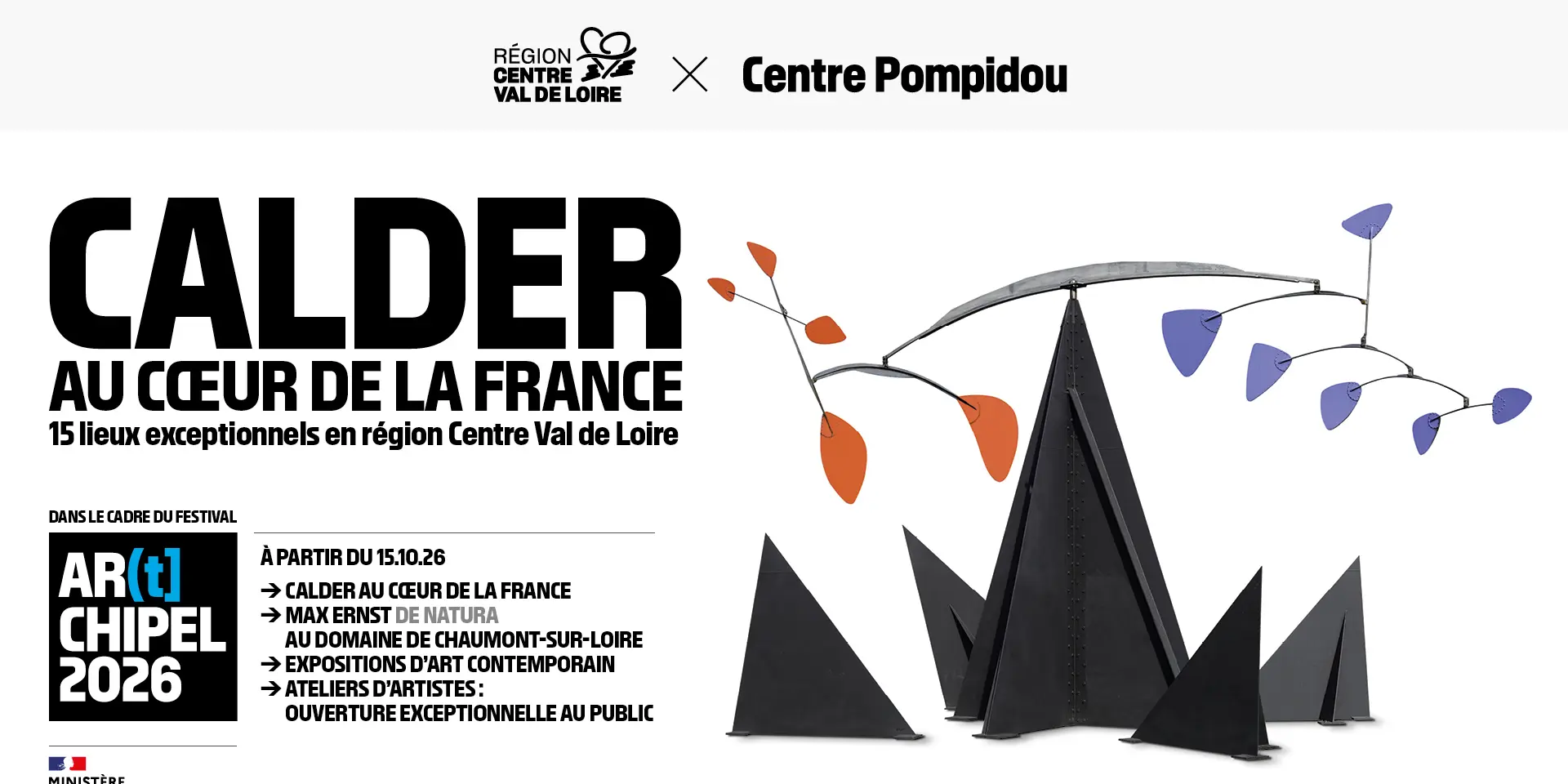
Alexander Calder in the spotlight at the AR(t]CHIPEL 2026 festival

Take advantage of autumn 2026 to discover or rediscover the works and life of Alexander Calder, to mark the centenary of his move to France! The famous American artist will be showcased in a number of venues across the Centre Val de Loire region, in the 4th edition of the AR(t]CHIPEL festival, which will take the works of the Centre Pompidou on the road while it is closed for works.

Focus on 2 exhibitions in Tours Alexander Calder in the spotlight at AR(t]CHIPEL

At the CCCOD – From 10 July to 3 January 2027

The Idea of Celestial Bodies exhibition: immerse yourself in the black gallery to admire works by Attila Csörgö, Jeppe Hein, Žilvinas Kempinas, Jaume Plensa, Valerie Snobeck, Francisco Tropa and Hema Upadhyay. All these artists have spent time in residence at the Calder workshop in Saché, Touraine. Their work blends science and poetry, focusing on light, volume, the body and time. Movement and balance, so dear to Alexander Calder, are never far away! Marc Fornes’ work will be on show in the nave from 10 July to 13 September.

Hôtel Goüin – 14 October 2026 to 17 January 2027

In addition to his best-known works, Alexander Calder’s works on paper – gouaches, lithographs, aquatints and plans for sculptures – reveal a graphic language vibrant with movement, rhythm and colour.

The Amboise Crinkly

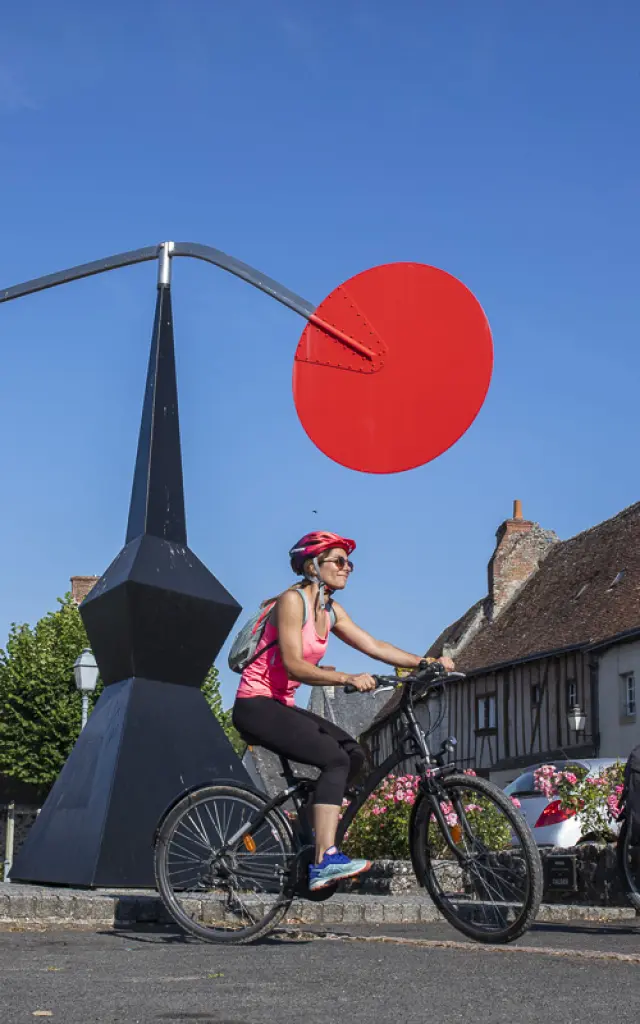
Admire the American artist’s stabile-mobile on the esplanade of the church of Saint-Florentin, near the Royal Château of Amboise and the Bigot chocolate factory. All the more reason to visit Amboise!

Good plan Tours City Pass

All admissions to sites in Touraine paying tribute to Alexander Calder are included in the 24h, 48h and 72h City Pass Tours!

Calder in the spotlight several visitor sites in autumn 2026

Detailed programme to follow

Alexander Calder in a few words An artist in Saché, Touraine.

Born in Pennsylvania in 1898, Alexander Calder (nicknamed “Sandy”) initially studied geometry, physics and chemistry, before applying to art school in New York. His father (a sculptor) and mother (a painter) undoubtedly contributed to his love of design, which led him to cross the Atlantic and settle in France in 1926. After painting, followed by wire creations, his encounters in Paris led him to the field of abstraction, which he combined with his taste for movement. He created his “mobiles”, named by Marcel Duchamp, the precursor of contemporary art.
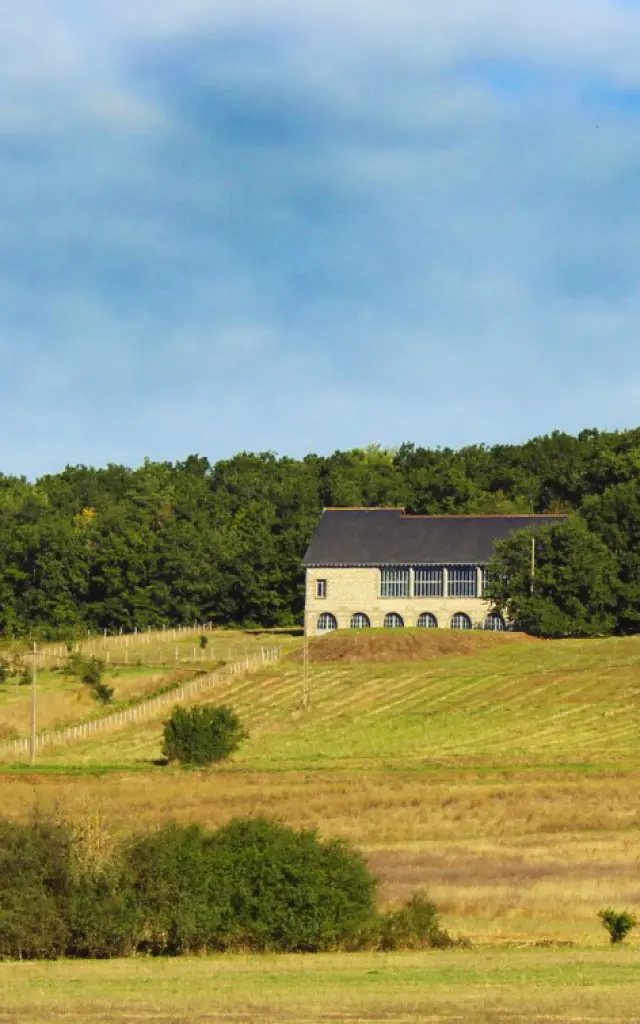
Although the rise of fascism in Europe forced him to return to the United States, Sandy returned to France after the Second World War. With his wife, he discovered the village of Saché, where his son-in-law’s family owned a manor house. Like Honoré de Balzac a century earlier, he fell under the spell of Touraine and decided to settle there. In 1963, he built a large studio on the Carroi site in Saché, overlooking the Indre valley, where he created his Stabiles, monumental sculptures composed of metal plates riveted together, which he had made in an industrial forge in Tours. He also had his house built there in 1969.

Le Lys dans la Vallée walk

Departing from the Musée Balzac in Saché, take in the fresh air on this 13km walk past Calder’s mobile “Totem ” near the church, then on to the Atelier Calder before reaching Pont-de-Ruan, through the beautiful landscapes of the Indre valley.

Elsewhere in the region with the AR(t)CHIPEL festival

Alexander Calder is also featured in other departments of the Centre Val de Loire region:

  • In Loir-et-Cher: Château de Chambord, Château de Blois. The Domaine de Chaumont-sur-Loire will also be hosting the De Natura exhibition (from 15 October to February 2027), devoted to Max Ersnt, a contemporary of Alexander Calder who also lived in Touraine.
  • In Eure-et-Loir: musée des Beaux-Arts de Chartres, l’ar[T]senal de Dreux.
  • In Loiret: Musée des Beaux-Arts d’Orléans, Les Tanneries d’Amilly.
  • Indre: Musée de l’Hospice Saint-Roch in Issoudun.

These events are the fruit of a partnership between the Centre Pompidou, the Centre Val de Loire Region, the Calder Foundation and the Fondation Louis Vuitton, with the support of Dior. The programme offers a sensitive, cross-disciplinary approach to Calder’s work, from sculpture and drawing to jewellery. It is aimed at a wide audience.